
How to Choose the Best Car Mats in Malaysia
Most car mat comparisons argue about thickness and price. Neither predicts which set you will still be happy with in two years. Six things that do.
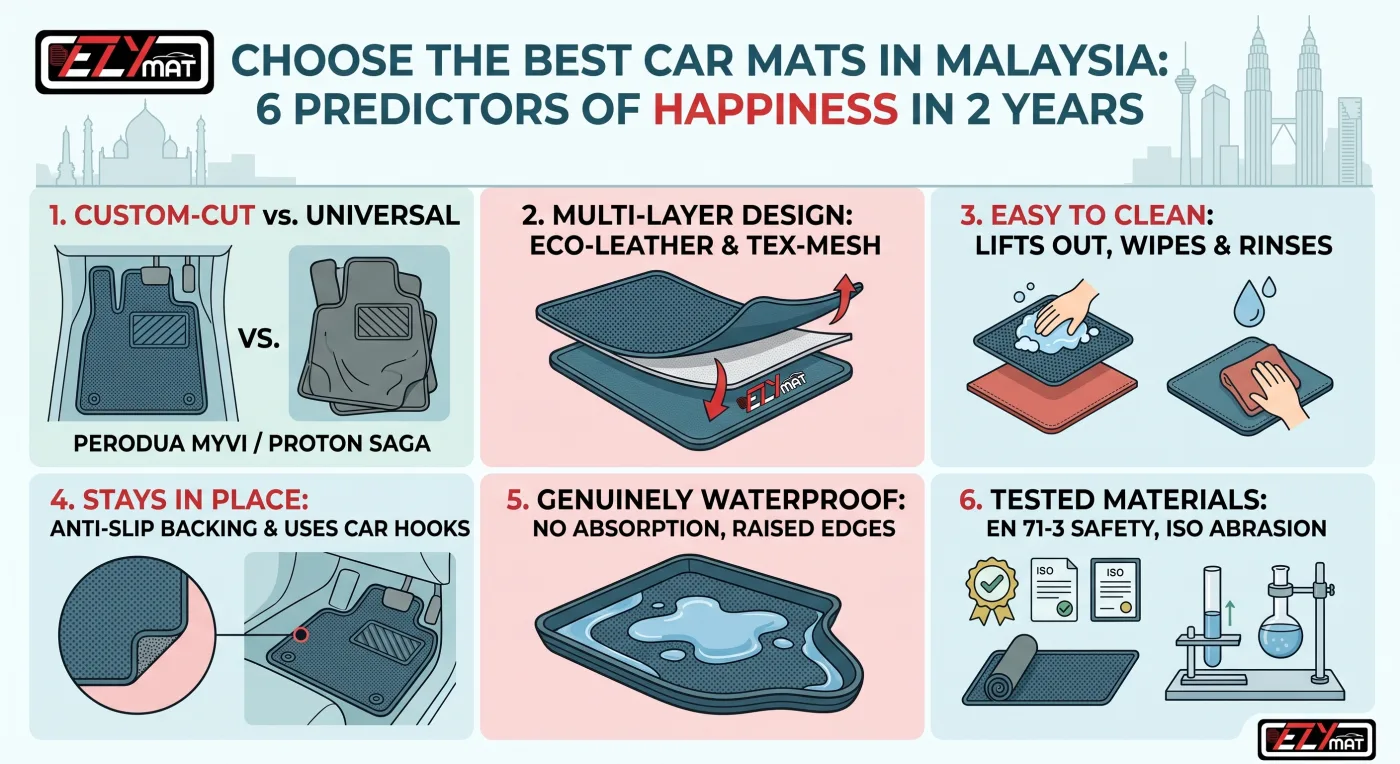
Almost every car mat comparison you will read comes down to two numbers: how thick it is and what it costs. Neither one tells you whether you will still be happy with the set in two years.
Here is what actually separates a set that works from one that annoys you, in roughly the order it matters.
1. Cut for your car, or trimmed to fit
This is the difference that makes the others matter or not.
A universal mat is a blank shape sold for any car and made to fit yours by being cut down, folded under, or simply left overlapping. The footwell of a Myvi and the footwell of a Vios are not the same shape, and a blank cannot be both.
What that costs you is not looks. A mat that does not match the well has nowhere to sit still, so it moves. Spills run off the edge instead of being held. And the part you were trying to protect is the part still exposed.
A custom-cut set is made from a template taken off that specific make, model and year. Ask any seller which they are selling you. The answer is usually in whether they ask you for your car before they take your money.
2. One material, or two doing different jobs
Most mats are one material asked to do two contradictory jobs: be waterproof, and be pleasant to put your feet on.
A single rubber tray is genuinely waterproof and feels like a rubber tray. A carpet mat feels right and absorbs everything you spill.
The way around that is to stop asking one layer to do both. An EZYMAT set is two: an Eco-Leather base, a solvent-free protein leather, which is the waterproof shell between the mess and your original carpet; and a Tex-Mesh top — woven fibre with wear-resistant PVC — on the strip your shoes actually land on.
The base covers the driver, front passenger and rear floor. The top layer covers the positions where feet land and deliberately not the centre tunnel.
3. Can you clean it, or only replace it
Ask this before you buy, not after the first monsoon.
The question worth asking is what happens to the dirty part. If the whole mat has to come out, get hosed and then take a day to dry, cleaning becomes something you avoid. If the material absorbs water, a flooded footwell usually means replacement.
On a two-layer set the top layer lifts out on its own, so the part that gets dirty is the part you rinse, and it drains and dries quickly. The base wipes clean. Whatever set you are looking at, work out which of those two situations you are buying into.
4. Does it stay where you put it
A mat that creeps forward is not a comfort problem. It is the one genuine safety issue in this whole category, because where it creeps to is the pedals.
Two things hold a mat still: the retaining hooks your car already has, and the backing. A set that ignores your car's hooks is relying entirely on friction. Look for an anti-slip backing and a cut that actually seats on the hooks — and after fitting any set, work the pedals through their full travel before you drive. Our installation guide covers what to check.
5. What "waterproof" is supposed to mean
The word gets used loosely. It should mean two specific things.
First, the material itself does not absorb water — not that it resists it for a while. Second, the edge is raised enough to hold a spill on the mat instead of letting it run over the side into the carpet, which is the thing you were protecting.
A mat can be made of waterproof material and still be useless at this if it is flat, because water does not stay where it lands in a moving car.
6. What the material has actually been tested for
Very little of this category publishes anything, so it is worth asking.
The Eco-Leather we build on was tested against EN 71-3, the European toy safety standard, for migration of certain elements, and passed in Category III. Formaldehyde was not detected under ISO 14184-1, and all 24 restricted aromatic amines from azo dyes were not detected. It was also run through a dry Martindale abrasion test to ISO 12947-2 with no wear at 100,000 rubs.
Three honest notes on that, because the way these numbers are usually quoted is misleading. It is SST report 26002338, dated 18 July 2026. It was commissioned by the material supplier, not by us, which is normal for a material certificate. And it covers that one material — the base layer — rather than the finished mat. "The eco-leather we use is tested to" is accurate; "our mats are certified" would not be.
What to ignore
Thickness quoted on its own. A thicker mat is not automatically better and can raise the floor enough to interfere with the pedals. What matters is whether the shape holds.
"Fits most cars." That is a description of a universal mat wearing better wording.
Questions worth asking any seller
Whoever you buy from, including us, these five answers tell you what you are getting:
- Do you have a template for my exact make, model and year, or are you cutting one down?
- Which part gets dirty, and how do I clean it?
- What happens if my footwell floods?
- How does it stay in place, and does it use my car's hooks?
- What has the material been tested for, and by whom?
A seller who can answer all five has thought about the product. One who answers with thickness and a discount has not.
If you want to see what the answers look like for a specific car, select your make, model and year — whichever pattern you pick is cut from the template for that car.