
Caring for Your Car Floor Mats Through a Malaysian Year
Mats rarely wear out. They get killed by three things, all avoidable, and two of them happen in the monsoon. What a set actually has to survive here.
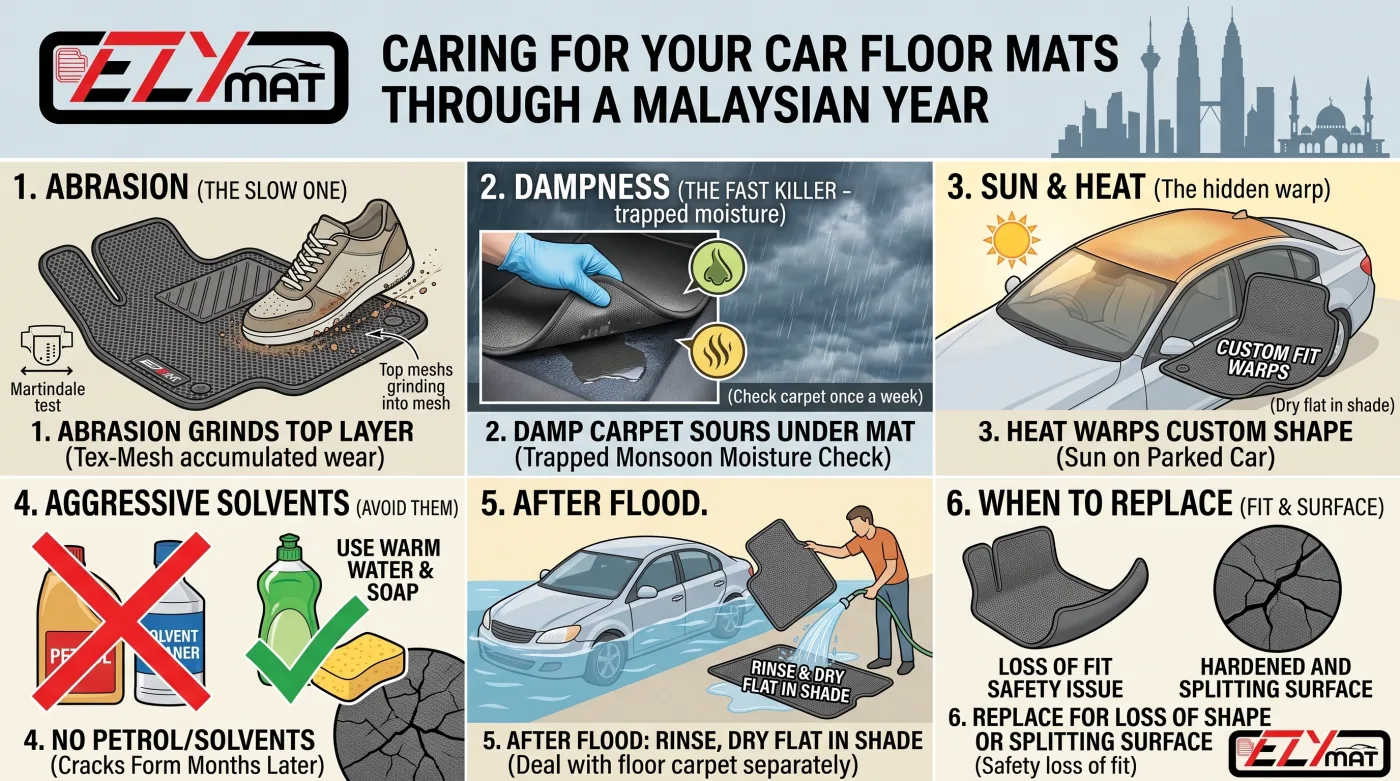
A set of mats in Malaysia has an easier life than one in a country with road salt and a hard winter, and a harder life than most people assume. The enemy is not cold. It is water that never quite leaves, grit carried in on wet shoes, and hot sun on a car parked outside.
This is about making a set last years rather than about the weekly routine — that is covered separately in how to clean car mats. What follows is what actually ends a mat's life, and what a set has to cope with over a year here.
Abrasion is the slow one, and it is measurable
Every time someone steps in, whatever is on their shoes grinds against the surface. That is the wear that accumulates.
The Eco-Leather we use was run through a dry Martindale abrasion test to ISO 12947-2 and showed no wear at 100,000 rubs, checked along the way at 20,000, 40,000, 60,000, 80,000 and 100,000. That is a genuine number rather than a marketing one, and it is worth being precise about what it covers: it is an abrasion test on the base material. It says nothing about a sharp edge, a tear or a puncture, and it does not cover the Tex-Mesh top layer, which is a different material.
What it means in practice is that scuffing from shoes is not what will finish the set. Most of that scuffing lands on the top layer anyway — which is exactly why that layer is the one built to lift out and be rinsed.
Damp is the fast one
Abrasion takes years. Trapped moisture takes a fortnight.
Water gets underneath a mat far more easily than people think: wet shoes carry it past the edge, and it runs down into the footwell and sits on the original carpet. The mat above it is waterproof, so nothing evaporates. What develops is not a mat problem at all — it is the carpet underneath going sour with a lid on it.
Through the monsoon this is worth a habit rather than a reaction. Once a week, lift the mats out and put a hand on the carpet underneath. If it is damp, leave the mats out and the car open until it is not.
If a smell keeps returning even with dry mats, stop looking at the mats. Check the door seals and the air-conditioning drain. A mat cannot cause a leak. It can only hide one, and a recurring smell in a car with dry mats is usually one of those two.
Sun is the one nobody counts
A dark surface parked in the open at midday gets considerably hotter than the air around it. Over enough afternoons that heat works on the shape.
This matters more for a custom-cut mat than for a universal one, because the whole value of a custom cut is that the raised edge follows the actual shape of your footwell. A mat that has warped no longer does that, and the fit you paid for quietly stops existing.
The practical version of this rule is short: when you wash a set, dry it flat and in the shade. Never on a driveway in direct sun, and never draped over something that will put a bend in it while it is warm.
After a flood
Malaysian flash floods do not give much notice, and a footwell can take water fast.
The material holds no water inside it, so a set that has been through a flood can usually be washed and put back. Take the mats out, hose both sides down, and dry them flat in the shade before they go anywhere near the car again. That is genuinely different from a carpet mat, where the water goes into the pile and stays there, and replacement is usually the only option.
Deal with the floor of the car as a separate job, and take it seriously. The mats will be fine long before the carpet is, and putting dry mats onto a wet floor recreates the problem in section two.
What not to put on them
Petrol, thinner and general-purpose solvent cleaners harden the material and make it crack.
There is nothing that lands on a car mat in normal use that needs a solvent. Warm water and plain dish soap handles it.
What the material was tested for
Worth knowing if you carry children or a dog, because they spend more time in contact with the floor than anyone else does.
The Eco-Leather layer was tested against EN 71-3, the European toy safety standard, for the migration of certain elements, and passed in Category III. Formaldehyde was not detected under ISO 14184-1, and all 24 restricted aromatic amines from azo dyes were not detected either.
Two honest qualifications. That is SST report 26002338, dated 18 July 2026, and it was commissioned by the material supplier rather than by us — which is normal for a material certificate and worth saying plainly. And it covers that one material, not the finished mat. The right way to put it is that the eco-leather we build on has been tested to the standard used for toys.
When to replace a set
Not on a schedule. On two signs.
The first is fit: if a mat no longer sits flat in the footwell, or creeps forward under braking, it has lost the shape it was cut to and it is now a safety question rather than a cosmetic one.
The second is the surface splitting rather than looking tired. Tired is fine. Cracked or split is not, because a split lets water through to the carpet the mat is there to protect.
Short of those two, a set that gets rinsed and dried properly should outlast most people's patience with the car it is in. If yours has reached the end, pick your make, model and year and we will cut the next one from the same template.